My previous post about of Mark Doty’s view of the relationship between the limitations of our perceptions and our ability to put our experience into words got me thinking about my own experience trying to write a poem about dreams I have had. I wrote about several dreams because I could not recall enough about one single dream to create a whole poem. I now realize that when I began to write my poem I was also influenced by things that I had come in contact with in my daily life and fragmented memories. My poem has been published three times but perhaps I cannot state that my poem has been published three times because each version is different and I changed the title once. My poem changed through oral performance and visual representations. Each version exists in print and one version is also on canvas. For me, they are all living simultaneously side by side but incomplete. They are parts of a whole that I could not imagine at once. When I think of oral poems that were written down and/or translated, I wonder what has been lost from the oral tradition and/or original language and if there is a way to rediscover the missing pieces. How can we discover the meaning of a poem if we do not have the final version or are missing parts of it? Some of my questions have been answered by Dennis Tedlock in his book, The Spoken Word and the Work of Interpretation and I will share some of Tedlock’s research in my next post.
I am including all three versions of my poem and the painting I created.
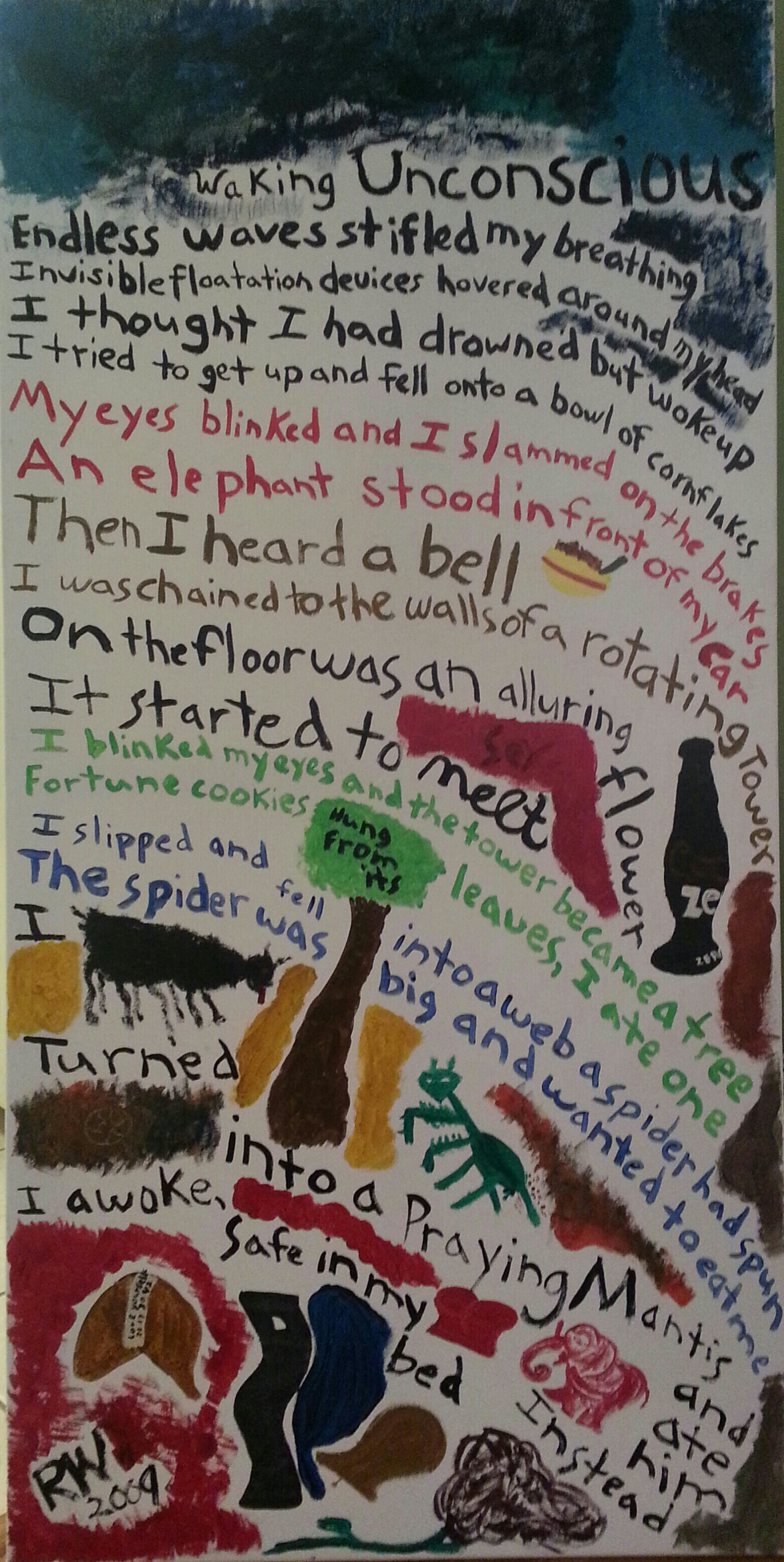
Plethora Vivid-Waking Unconscious
 Verbal Pathways in Humanities: The Relationship between Orality, Literacy and Digital Media